Photo-Me
13days avg
Digital booth photo with HMPO photo code
Based on 152 published timelines


Recommended passport photo partner
Get Your Passport Photo Right First Time
Choosing the right passport photo can make all the difference.
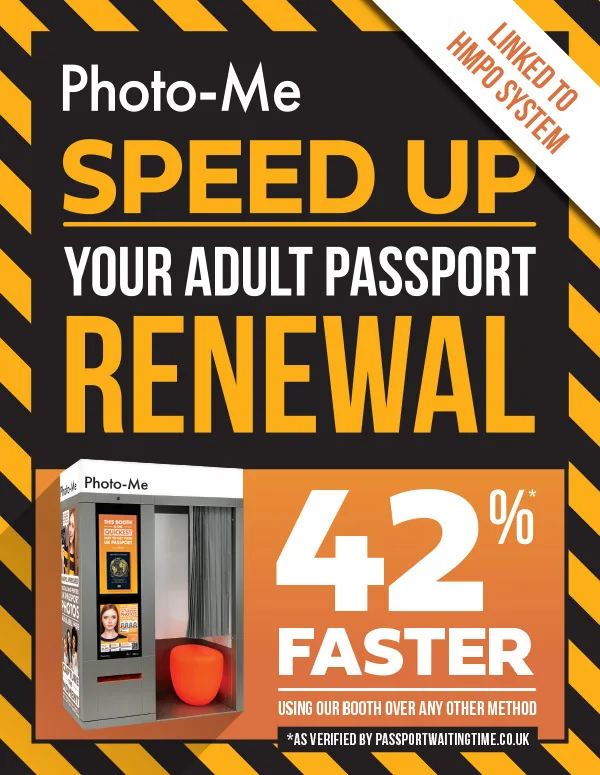
Based on thousands of applicant timelines submitted to Passport Waiting Time, people using Photo-Me digital passport photos are currently seeing faster average processing times than applicants using mobile phone photos.*
Photo-Me sends your photo digitally to HM Passport Office using a unique photo code, helping reduce the chance of your application being delayed due to photo issues.
*Based on crowd-sourced Passport Waiting Time user submissions. Processing times vary and this should not be interpreted as a guarantee.
HMPO compatible digital photos
Digital code for online applications
Thousands of real applicant timelines
Recommended by Passport Waiting Time
Why Photo-Me?
Unlike taking a passport photo yourself with a mobile phone, Photo-Me booths are designed specifically for passport applications.
Booth lighting is calibrated for even face illumination so HM Passport Office can see your features clearly.
Backgrounds are set up for cream or light grey requirements — no busy walls or shadows behind you.
Guides help you face the camera squarely with your head at the right height and angle.
Output is sized for UK passport applications so you are not guessing crop ratios on a phone.
Booths run checks designed for official photo standards before you leave with a code.
Receive a unique code to enter in your online application — no printing or scanning required.
Thousands of Photo-Me locations in shopping centres, stations and high streets nationwide.
Fewer common DIY mistakes — glare, wrong background, soft focus — that delay applications.
Passport Waiting Time data
Every day Passport Waiting Time receives timeline submissions from passport applicants. One of the optional questions asks how applicants took their passport photo. Using this data we can compare average processing times across photo methods.
Photo-Me
13days avg
Digital booth photo with HMPO photo code
Based on 152 published timelines
Mobile phone
23days avg
Self-taken phone photos submitted online
Based on 503 published timelines
Other methods
24days avg
Other booths, studios and alternative methods
Based on 345 published timelines
Averages are calculated from crowd-sourced eligible submissions. Individual cases vary. These figures are real-world indicators, not guarantees, and Passport Waiting Time remains independent of HM Passport Office and Photo-Me.
Community timelines
Recent published timelines where applicants said they used a Photo-Me photo booth. Processing days are calendar days from submission to passport received.
Photo-Me timeline
4days
Photo-Me timeline
6days
Photo-Me timeline
22days
Photo-Me timeline
13days
Photo-Me timeline
12days
Photo-Me timeline
28days
HM Passport Office rules
Your UK passport photo must meet official standards. Here is each rule in plain English.
Taken within the last month so it still looks like you.
Full colour photos only — black and white is not accepted.
No soft focus, motion blur or pixelation.
Eyes must look natural with no flash red-eye effect.
Your face should be the sharpest part of the image.
Chin to crown visible; nothing cropping your face.
Eyes toward the lens, head not turned.
A relaxed face — no big smiles showing teeth.
Lips together unless a medical reason applies.
Both eyes open and clearly visible (babies have limited exceptions).
Fringes and hair must not cover eyes or eyebrows.
No patterns, textures, outdoor scenes or coloured walls.
Light should fall evenly across your face with no hotspots.
No shadows on your face or behind you on the background.
No filters, beauty apps, retouching or digital alterations.
These mistakes cause delays and rejections. Avoid them before you apply.
Eyes must be fully visible without dark lenses.
Hats and caps are not allowed except approved religious coverings.
Beauty filters and effects can cause rejection.
Arms-length selfies often distort your face.
Keep a neutral expression with mouth closed.
Keep your head level and facing the camera.
Patterns and objects behind you fail compliance.
Only you should appear in the frame.
Do not cut off chin, forehead or ears incorrectly.
Soft or shaky photos will be rejected.
Screenshotting an old photo usually fails quality checks.
Cropped Instagram or Facebook images are not suitable.
Baby and infant photos follow most adult rules, with a few important differences that trip people up.
HM Passport Office allows glasses in some cases, but glare and frames cause many rejections. If you can take the photo without glasses, that is usually safer.
If you normally wear glasses, try removing them for the photo unless you need them for medical reasons and can meet every rule above.
Religious head coverings are allowed provided your face is fully visible from chin to forehead and both edges of your face, with no shadows cast by the covering.
If a medical condition means you cannot meet a standard photo rule (for example expression or eyes open), HM Passport Office guidance allows supporting evidence in some cases. Check the latest GOV.UK passport photo rules for current medical exemption requirements before you apply.
Understanding why photos fail helps you get it right before you apply.
Uneven light, overexposure or underexposure hides facial detail.
Shadows on the face or background are a common reason for rejection.
Coloured, patterned or outdoor backgrounds do not meet HMPO rules.
Camera shake or soft focus makes identity checks unreliable.
Beauty mode and colour filters change your appearance.
Fringes or loose hair over eyes or face fail compliance.
Standing too far away leaves your face below the required size in frame.
Looking away or tilting the head breaks the full-face rule.
Flash reflections hide the eyes even when frames are thin.
Compressed phone images can look blocky when enlarged.
Incorrect head height or cut-off edges fail automated checks.
Photos older than a month may no longer look like you.
Practical advice whether you use a Photo-Me booth or carefully follow DIY rules.
Use natural daylight or a booth with calibrated lighting — avoid harsh overhead bulbs.
Stand against a plain cream or light grey wall if you are not using a booth.
Turn off phone beauty filters and portrait “smooth skin” modes.
Tie back long hair so it does not fall across your eyes.
Check the image carefully before you submit your application.
Wear normal everyday clothing — avoid uniforms unless required.
Avoid white tops against white backgrounds; contrast helps definition.
Remove sunglasses, headphones and hats before the photo is taken.
A practical comparison between typical mobile-phone photos and Photo-Me booth photos.
| Factor | Mobile phone | Photo-Me |
|---|---|---|
| Lighting | Depends on room and time of day | Calibrated booth lighting |
| Background | Easy to get wrong at home | Compliant plain background |
| Compliance checks | Manual self-check only | Automated booth checks |
| Digital code | Usually print or upload a file | Unique code for online applications |
| Acceptance confidence | Higher chance of common mistakes | Designed for HMPO standards |
| Convenience | At home, but trial and error | Quick booth visit nationwide |
| Chance of needing a retake | Often higher for first attempts | Lower when booth guidance is followed |
Answers to the most common UK passport photo questions — including digital codes, babies, glasses and Photo-Me booths.
You should have a neutral expression with your mouth closed. A slight natural look is fine, but smiling with teeth showing can lead to rejection.
Yes. Wear makeup as you normally would day to day. Avoid heavy effects or filters that change how you look.
Yes, ordinary jewellery is usually fine as long as it does not obscure your face and there is no glare covering your features.
Babies do not need the same neutral expression as adults. A natural expression is acceptable, and eyes may be closed if the child is under one.
You can submit a phone photo for many online applications if it meets every HM Passport Office rule. Many people find booths easier because lighting, background and sizing are handled for them.
Your photo should be recent — generally taken within the last month — and must still look like you.
Glasses are allowed only if there is no glare, your eyes are fully visible, lenses are not tinted and frames do not cover your eyes. Removing glasses is often safer.
No. Headphones, wireless earbuds and similar accessories should be removed so your face and ears are clear.
Hats and fashion headwear are not allowed. Approved religious head coverings are permitted if your face is fully visible with no shadows.
A hoodie is fine if the hood is down and nothing covers your face or casts shadows. Keep the background plain.
Yes. Hair colour is not restricted. Make sure hair does not cover your eyes and that you still look like yourself.
Only if it still meets current passport photo rules and is recent enough. Do not assume an old licence photo will pass.
No. Do not use filters, retouching apps or digital alterations. Edited photos are commonly rejected.
Only if it is still recent, still looks like you and meets today’s rules. Reusing an outdated photo risks delay or rejection.
A digital photo code is a unique reference from a compliant booth (such as Photo-Me) that lets HM Passport Office retrieve your photo electronically when you apply online — without uploading a phone file.
Photo-Me booths are built for official photos: compliant background, lighting, positioning guidance and a digital code for online applications, which helps reduce common DIY mistakes.
Use the Photo-Me booth finder to locate machines in shopping centres, stations and high streets across the UK. The link on this page opens the official finder.
Find a Photo-Me booth near you, follow the on-screen guidance, and collect your digital photo code for your online UK passport application.
Passport Waiting Time is an independent website using crowd-sourced passport processing data. Photo-Me is a commercial partner. Our editorial content remains independent and our statistics are generated from real user submissions.